
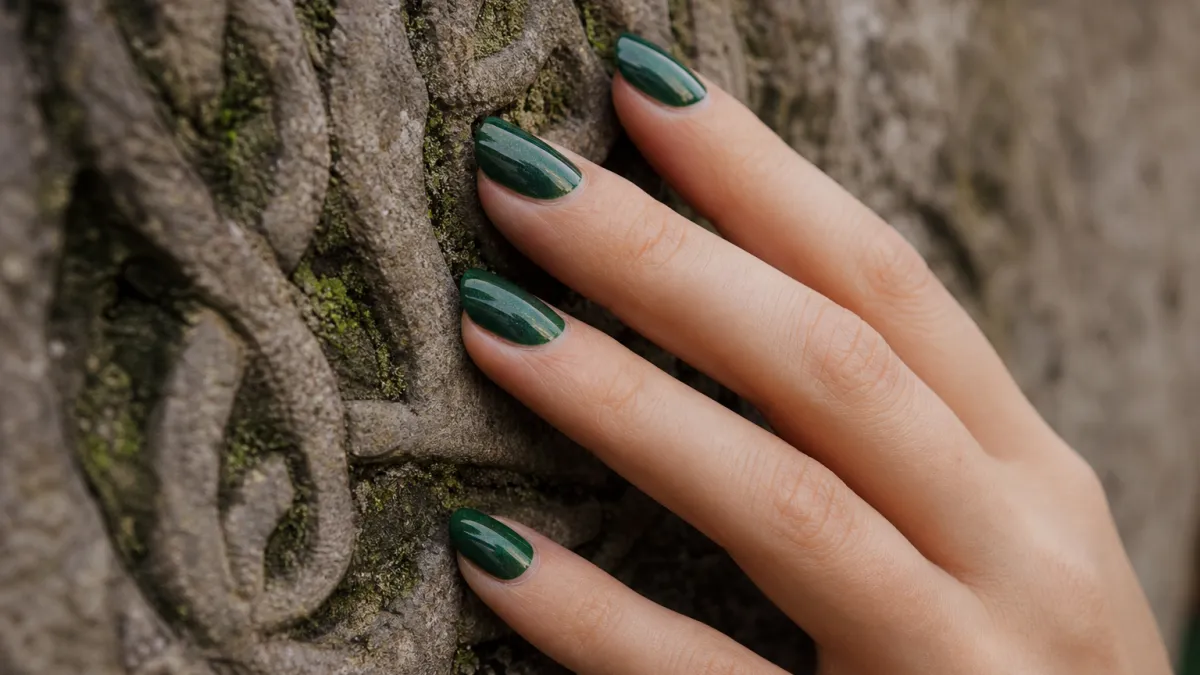
Celtic nail art is too often reduced to a shamrock sticker. The real design leverage lies in interlaced knotwork and heraldic geometry — symbols from Saint Patrick's and Saint George's traditions that transform a simple manicure into genuine cultural craftsmanship.
Les racines des festivités
Two dates, two saints, two visual languages. Saint Patrick's Day and Saint George's Day each carry a distinct symbolic grammar — one built on green and folklore, the other on red geometry and legend.
L'histoire de la saint patrick
Le 17 mars n'est pas une date arbitraire. Elle marque la mort présumée de Patrick, un moine romano-britannique du Ve siècle, capturé et réduit en esclavage en Irlande avant de s'en échapper, puis d'y revenir comme missionnaire.
C'est ce retour volontaire qui façonne le personnage. Patrick n'est pas venu en conquérant. Son travail d'évangélisation, mené dans un territoire celtique profondément ancré dans ses propres croyances, a progressivement fait de lui le saint patron de l'Irlande.
La fête qui porte son nom a longtemps été un jour de recueillement religieux. Ce n'est qu'au fil des siècles, notamment sous l'impulsion des communautés irlandaises expatriées, qu'elle est devenue la célébration publique que vous connaissez aujourd'hui — défilés, port du vert, rassemblements. Le vert, couleur associée à l'Irlande, a progressivement supplanté le bleu, couleur d'origine liée à saint Patrick.
Les symboles de la saint george
Le 23 avril marque Saint George's Day, une date ancrée dans le calendrier anglais depuis le Moyen Âge. La célébration gravite autour d'un symbole visuel immédiatement reconnaissable : la croix rouge de Saint George, une croix écarlate sur fond blanc qui constitue le cœur même du drapeau anglais.
Ce motif graphique a une logique historique précise. La croix rouge était portée par les croisés anglais au XIIe siècle comme signe de ralliement, avant de devenir l'emblème national. Pour le nail art, ce bicolore tranché — rouge carmin sur blanc pur — offre une base géométrique nette, idéale pour des designs en négatif ou en overlay.
L'autre symbole dominant reste le dragon, directement lié à la légende fondatrice où Saint George terrasse la créature. Ce motif reptilien, aux écailles et aux flammes, ouvre un registre graphique plus complexe, parfait pour un nail art texturé ou en relief.
These origins are not decorative detail. They are the structural logic behind every colour choice and motif you will apply to your nails.
Créations de nail art inspirées
Three variables determine the result: the colours you select, the techniques you apply, and the accessories you layer. Each one operates on a distinct logic.
Palette de couleurs idéales
Colour selection is where most nail art designs succeed or fail before the first stroke is applied. For Celtic and British celebrations, the palette is not decorative — it is symbolic code that triggers immediate cultural recognition.
- Emerald green saturates the nail with the visual weight of Irish identity; pair it with gold glitter to create contrast that reads as festive rather than flat, since matte green alone loses its ceremonial dimension under artificial light.
- White acts as a technical reset between green and gold, preventing chromatic saturation across a full set of ten nails.
- Crimson red on Saint George's Day carries the precise heraldic tone of the English cross; a blue-toned red will drift visually and lose the reference entirely.
- White and blue complete the Saint George's palette by replicating the flag's structural geometry directly onto the nail surface.
- Combining both celebrations across a single set — emerald on one hand, crimson on the other — produces a deliberate dual-heritage statement that reads with clarity.
Techniques spécifiques de nail art
Stamping is the technique that resolves the most common frustration in Celtic nail art: replicating geometrically precise knots by hand. A stamping plate transfers the full design in a single press, eliminating distortion on curved nail surfaces. From there, three approaches define the technical hierarchy:
- Stamping locks in complex Celtic knotwork or St George's cross patterns with consistent line weight — the plate does the precision work your brush cannot replicate at that scale.
- Freehand painting gives you control over personalisation: adjusting shamrock proportions, thickening dragon outlines, or blending gradient fills within a pre-stamped border.
- Decals reduce application time significantly — suited to detailed imagery like heraldic dragons where hand-painting would demand professional-level brush control.
- Layering stamping over decals adds dimensional contrast: the stamped design sits above the flat decal surface, creating visible depth.
- Combining a stamped Celtic border with a freehand central motif produces the most considered result — structure and individuality working within the same composition.
Accessoires indispensables
The right accessory transforms a competent design into a statement piece. Three categories deliver the most reliable results for Celtic and British-inspired nail art.
Rhinestones create genuine three-dimensional relief. Placed at the tip of a shamrock or along a St George's Cross motif, they catch light in a way flat polish cannot replicate. Position them whilst the top coat is still tacky — this is the mechanical window for adhesion.
Glitter works differently. Its effect is cumulative: a single coat reads as texture, two coats read as depth. Applied over a sheer green or red base, it amplifies without overwhelming the underlying design.
Nail stickers serve a precise function — they standardise complex motifs across all ten nails simultaneously. For intricate knotwork patterns that would take considerable skill to paint freehand, a quality sticker delivers consistency without compromise.
The sequence matters: base colour first, decorative accessories second, top coat last to seal and protect every element.
Colour, technique, and accessories are not independent choices — each decision conditions the next, and the final design is only as strong as the weakest link in that sequence.
Astuces pour une finition impeccable
The most common mistake in nail art is skipping the top coat. Without it, even the most precise Celtic knotwork or St George's Cross design chips within 24 hours of application.
A quality top coat acts as a protective seal — it locks pigment in place and amplifies the glossy depth of your design. The mechanism is straightforward: the formula creates a hard, transparent layer that absorbs surface friction before it reaches your artwork. You preserve the geometry of every line, every dot, every carefully placed detail.
Cuticle care operates on a different but equally logical principle. Dry, ragged cuticles draw the eye away from the nail plate itself. Moisturised cuticles create a clean visual boundary that makes the overall finish appear more deliberate and controlled. Apply a dedicated cuticle oil or cream before your final top coat layer — the skin around the nail reflects light differently when hydrated, and that contrast elevates the perceived quality of the design.
Two products, two distinct functions. The top coat protects the art; cuticle care frames it. Together, they ensure your St Patrick's shamrocks or your St George's red-and-white geometry remain sharp through every celebration.
Ces techniques — stamping, nail art au pinceau fin, feuille d'or — vous donnent les outils pour traduire l'iconographie celtique avec précision.
Choisissez un motif dominant par main. La cohérence visuelle entre les deux fêtes repose sur cette discipline chromatique.
Questions fréquentes
What nail art designs work best for Saint Patrick's Day?
Shamrock motifs, Celtic knotwork, and deep emerald gradients are the most effective choices. A fine nail art brush delivers cleaner linework than stamping plates for intricate knotwork patterns.
How do you create a Celtic knot nail design for Saint George's Day?
Use a thin striping brush with white or red polish on a neutral base. Trace interlocking loops systematically — each strand passes alternately over and under. Seal with a high-gloss topcoat to sharpen definition.
Which nail polish colours suit both Celtic and English heritage nail art?
Emerald green anchors Celtic designs; crimson red and white serve Saint George's cross motifs. Gold detailing bridges both aesthetics, creating visual coherence across a full set celebrating both traditions.